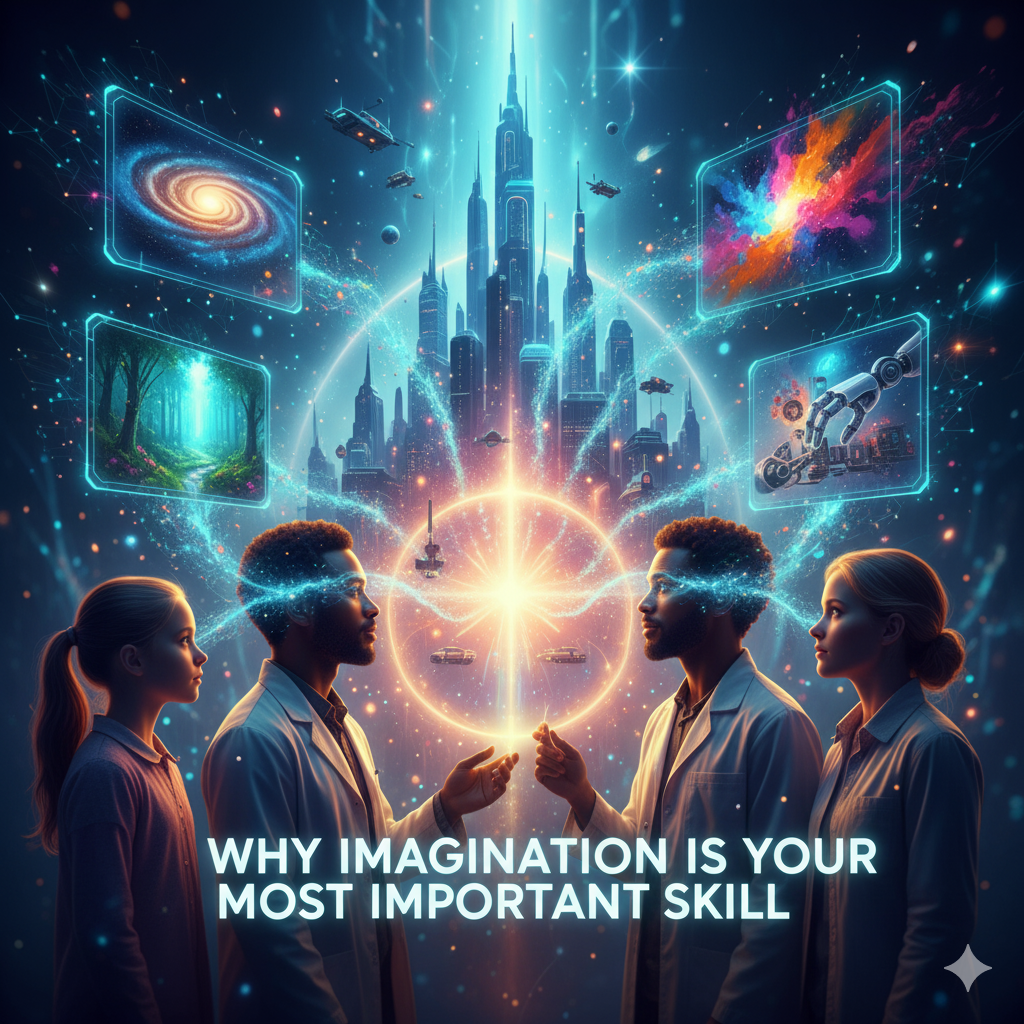
Of all the faculties bestowed upon the human mind, none is as transformative, as boundless, or as fundamentally human as the power of imagination. It is the silent architect of our world, the invisible engine of progress, and the intimate sanctuary of our deepest selves. More than mere daydreaming or fantastical escape, imagination is the profound cognitive ability to form new ideas, images, and concepts not present to our senses. It is the wellspring from which art, science, innovation, and empathy flow, bridging the chasm between what is and what could be.
At its core, imagination is an act of mental rebellion against the tyranny of the actual. Our senses are bound by the immediate—the chair we sit on, the words on this page, the sound of distant traffic. But our minds are not. We can, in an instant, project ourselves onto the surface of Mars, compose a symphony in a silent room, or reconstruct a conversation from a decade past. This ability to manipulate mental models is not a luxury; it is a fundamental tool for survival and advancement. Our prehistoric ancestors used it to envision the trajectory of a spear or the construction of a shelter, just as a modern engineer visualises a bridge before a single stone is laid. It is a form of mental rehearsal, a sandbox for the mind where we can test scenarios, solve problems, and innovate without the dire consequences of real-world failure.
The most tangible manifestation of imagination’s power is in the realm of science and technology. Every great invention, every paradigm-shifting theory, began as a fragile spark in someone’s mind. The Wright brothers did not merely tinker with wood and fabric; they first imagined human flight, defying the apparent logic of their era. Albert Einstein’s theory of relativity was born from a “thought experiment,” where he imagined chasing a beam of light. He manipulated concepts in his imagination long before they were verified by complex mathematics and observation. In this sense, science is not a cold collection of facts but a disciplined form of dreaming. The smartphone in your pocket, the internet connecting the globe, the medicines that cure diseases—all were once impossible fantasies, figments of imagination that stubborn individuals willed into reality. Imagination is the blueprint for creation.
Similarly, the entire edifice of art, literature, and music is a cathedral built by imagination. A novelist like J.K. Rowling does not simply describe a world; she constructs an entire universe—Hogwarts, its magic, its politics, its perils—from the raw material of her mind, gifting it to millions of readers who then, in turn, use their own imaginations to bring it to life. A painter like Picasso imagined a new way of seeing, deconstructing and reassembling form on canvas. Beethoven, even in his deafness, imagined symphonies of such profound emotional depth that they continue to stir souls centuries later. Art is the externalisation of the internal, a shared dream that allows us to see the world through another’s eyes and, in doing so, understand something new about our own humanity.
Beyond these grand, external achievements, the power of imagination is the very bedrock of human connection: empathy. Empathy is not merely understanding another’s feelings; it is the imaginative act of placing oneself in their situation, of feeling as they feel. When we read a news story about a refugee, it is our imagination that allows us to transcend our comfortable reality and, for a fleeting moment, grasp the fear, the loss, and the desperation of their journey. This capacity to “walk a mile in another’s shoes” is the foundation of morality, compassion, and social cohesion. It is what compels us to act kindly, to build just societies, and to recognise our shared humanity. Without imagination, we would be isolated islands of consciousness, incapable of truly understanding one another.
Furthermore, imagination is an indispensable tool for navigating the past and the future. Our memory is not a perfect recording; it is a reconstructive process. We imagine our past, piecing together fragments and narratives to form our identity. Similarly, we constantly use imagination to project ourselves forward. We imagine the outcome of a job interview, the joy of a future vacation, or the consequences of a difficult decision. This “prospective imagination” is crucial for goal-setting, planning, and motivation. It allows us to be architects of our own destiny, rather than passive passengers in the river of time.
However, the power of imagination, like any great force, is not inherently benevolent. It is a double-edged sword. The same faculty that allows us to envision utopia also enables us to conceive of dystopia. It is the source of our most uplifting hopes and our most paralyzing anxieties. When imagination runs unchecked by reason or reality, it can spiral into catastrophic thinking, fueling phobias and paranoia. The dark side of imagination is the breeding ground for prejudice, for we can imagine threats that do not exist and demonise groups we do not understand. History’s greatest atrocities were often justified by a viciously imaginative narrative that dehumanised others. Thus, the challenge is not merely to cultivate imagination, but to guide it with wisdom, ethics, and a firm connection to empathetic and rational principles.
In our contemporary, fast-paced world, there is a danger of stifling this vital capacity. Standardised education, with its emphasis on standardised tests and “right answers,” can inadvertently punish divergent thinking. The constant, passive consumption of pre-packaged digital media—the vivid, flashing visuals of video games and movies—can atrophy our own internal image-making muscles. Why build a castle in your mind when one is presented to you in 4K resolution? To neglect imagination is to risk a profound impoverishment of the human spirit. We become mere consumers of reality, rather than its creators.
Therefore, nurturing the imagination is a critical imperative. It requires carving out spaces for boredom and daydreaming, where the mind can wander without agenda. It involves immersing ourselves in the arts, reading fiction that transports us to other worlds, and engaging in creative play, regardless of our age. It means asking “what if?” with the relentless curiosity of a child and having the courage to pursue the answers, however unconventional they may seem.
In conclusion, the power of imagination is the defining characteristic of human potential. It is the invisible loom upon which we weave the fabric of our reality, from our most personal dreams to our most shared civilisational achievements. It is the tool of the scientist, the muse of the artist, the compass of the empath, and the architect of the future. To imagine is to be free—to reach beyond the limits of our physical existence and touch the infinite possibilities of what it means to be human. In the words of the physicist Albert Einstein, who knew a thing or two about its potency, “Imagination is more important than knowledge. For knowledge is limited, whereas imagination embraces the entire world, stimulating progress, giving birth to evolution.” It is, and will always be, our most powerful magic.
FAQs
1. What exactly is imagination?
Imagination is the mental ability to form images, ideas, and sensations that are not immediately present to your senses. It’s your mind’s internal workshop where you can visualize future scenarios, recall past events with creative license, invent new things, and explore possibilities beyond current reality.
2. Is imagination just for artists and children?
Absolutely not. While artists and children are often its most visible users, imagination is a critical tool for everyone.
Scientists use it to form hypotheses and visualize molecular structures.
Entrepreneurs use it to envision new businesses and solve market problems.
Engineers use it to design and test prototypes before building them.
Doctors use it to diagnose complex conditions.
In daily life, you use it to plan your day, have a conversation, or decide what to cook for dinner.
3. What’s the difference between imagination and creativity?
They are closely linked but distinct:
Imagination is the thinking stage. It’s the internal process of conceiving something new. (The “idea” phase).
Creativity is the doing stage. It is imagination applied to produce something tangible, novel, and valuable. (The “execution” phase).
You can imagine a beautiful painting, but you are being creative when you actually paint it.
4. Can imagination be harmful?
Yes, if left unchecked. The same power that allows you to envision wonderful possibilities can also conjure up fears and anxieties.
Anxiety & Worry: This is often “negative imagination” at work—catastrophizing and imagining the worst-case scenario.
Disconnection from Reality: While escapism is fine in moderation, living primarily in an imagined world can lead to neglecting real-life responsibilities and relationships.
The key is to direct your imagination, not suppress it.
5. What is “Visualization” and how is it related?
Visualization is a focused and deliberate use of imagination. It’s the practice of creating detailed, sensory-rich mental images of a specific desired outcome—like an athlete mentally rehearsing a perfect dive or a speaker practicing their speech in their mind. Neuroscience shows that visualization can strengthen neural pathways almost as effectively as physical practice.