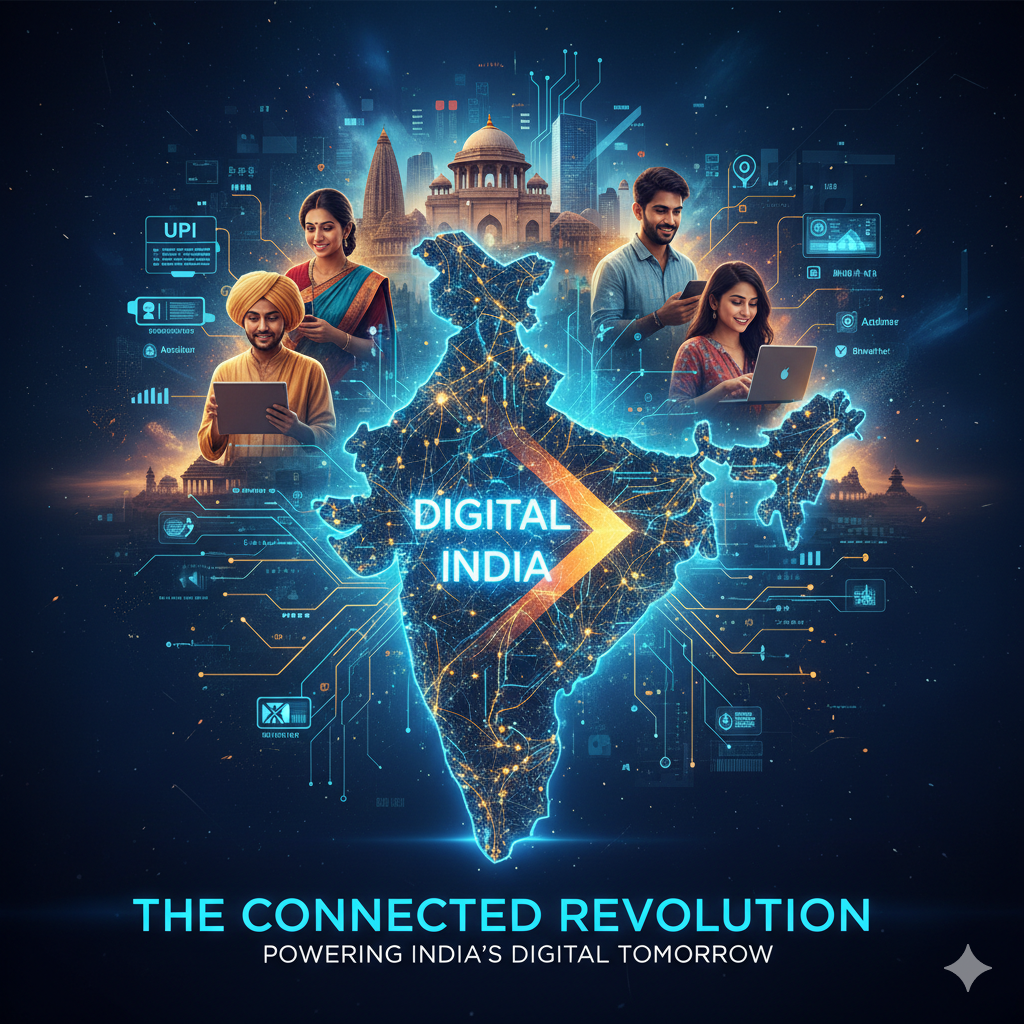
Launched on July 1, 2015, by Prime Minister Narendra Modi, the Digital India campaign stands as one of the most ambitious and transformative initiatives ever undertaken by the Government of India. Its core vision is to transform the country into a digitally empowered society and a knowledge economy. More than just a government scheme, it is a comprehensive philosophy that seeks to bridge the digital divide, reshape governance, and place technology at the heart of everyday life for every Indian citizen. The program is built on three fundamental pillars: digital infrastructure as a utility to every citizen, governance and services on demand, and digital empowerment of citizens.
Pillar 1: Creating a Robust Digital Foundation
The first pillar recognizes that reliable digital infrastructure is the bedrock upon which a connected nation is built. Without it, digital inclusion remains a distant dream. This vision has been pursued through several key initiatives:
- BharatNet: One of the flagship projects under this pillar, BharatNet aims to connect all 250,000 Gram Panchayats (village councils) in India with high-speed optical fibre. This creates a digital highway to rural India, enabling the delivery of e-services, e-education, and e-healthcare directly to villages, thus addressing the urban-rural digital chasm.
- Common Service Centres (CSCs): To ensure that digital services reach the last mile, especially in areas with low internet penetration or digital literacy, a vast network of CSCs has been established. These are physical facilities, often run by local entrepreneurs, that provide a range of G2C (Government to Citizen) and B2C (Business to Citizen) services. From applying for certificates and paying utility bills to accessing telemedicine and banking services, CSCs have become the face of Digital India in rural hinterlands.
- Universal Access to Mobile Connectivity: A massive drive to expand mobile network coverage, particularly in remote and left-wing extremism-affected areas, has been undertaken. The proliferation of affordable smartphones and competitively priced data plans, famously termed the “Jio effect,” has acted as a massive catalyst, bringing millions of Indians online for the first time.
Pillar 2: Reimagining Governance and Service Delivery
The second pillar focuses on leveraging technology to make governance more efficient, transparent, and citizen-centric. The motto “Minimum Government, Maximum Governance” is being realized through a move from a department-centric model to an integrated, on-demand service model.
- Unified Platforms and Digital Locker: Initiatives like the Unified Mobile Application for New-age Governance (UMANG) app provide a single platform for accessing central, state, and local government services. The DigiLocker system allows citizens to store important documents like driving licenses, vehicle registration, and academic certificates in a secure digital cloud, reducing the dependency on physical documents and minimizing bureaucratic red tape.
- Direct Benefit Transfer (DBT): By linking welfare schemes to Aadhaar (India’s biometric digital identity system), the government has been able to transfer subsidies and financial assistance directly into the bank accounts of beneficiaries. This has dramatically reduced leakages, eliminated ghost beneficiaries, and ensured that help reaches the intended recipients, saving the exchequer billions of dollars.
- E-Governance and Digital Workflows: From online tax filing (GSTN portal) and company incorporation to passport applications and land record digitization (e-District, National Land Record Modernization Programme), a multitude of government processes have been migrated online. This has not only reduced the scope for corruption and middlemen but has also made these services faster and more accessible.
Pillar 3: Fostering Digital Empowerment
The third pillar is about equipping citizens with the tools, skills, and access to participate fully in the digital world. It acknowledges that infrastructure and services are meaningless if people cannot use them effectively.
- Digital Literacy: The Pradhan Mantri Gramin Digital Saksharta Abhiyan (PMGDISHA) aims to make at least one person in every rural household digitally literate. This empowers individuals to operate digital devices, access the internet, and use government services, fostering greater social and financial inclusion.
- Promotion of Indic Languages: To break the language barrier, a major push has been given to developing digital content and keyboards in local Indian languages. This ensures that the benefits of the digital revolution are not confined to an English-speaking elite.
- Entrepreneurship and Innovation: Platforms like MyGov encourage citizen engagement in policy-making. Furthermore, the Start-up India initiative, closely aligned with Digital India, has fostered a vibrant ecosystem for tech entrepreneurs, leading to innovations in fintech, edtech, healthtech, and agritech that are solving uniquely Indian problems.
Impact and Tangible Outcomes
The cumulative effect of these interconnected initiatives has been profound:
- Financial Inclusion: The synergy between Digital India and the Jan Dhan Yojana (financial inclusion scheme) and Aadhaar has brought millions of unbanked citizens into the formal economy. The Unified Payments Interface (UPI), a real-time payment system, has revolutionized digital payments, making India a global leader in this domain.
- Ease of Living: For the common citizen, tasks that once required standing in long queues for hours—paying bills, booking train tickets, or applying for a certificate—can now be done with a few clicks on a smartphone.
- Transparency and Accountability: The digital trail left by online transactions and DBT has increased transparency, making it harder for funds to be misappropriated. Portals where citizens can track the status of their applications have introduced a new level of accountability in government offices.
- Economic Growth: Digital India has created a fertile ground for the digital economy to thrive. It has spurred job creation in the IT and IT-enabled services sectors, e-commerce, and the gig economy.
Challenges and the Road Ahead
Despite its remarkable successes, the Digital India journey is not without its challenges:
- The Digital Divide Persists: While infrastructure is expanding, a significant gap remains in internet penetration and quality between urban and rural areas, and between different socio-economic groups and genders.
- Cybersecurity and Data Privacy: As more and more critical citizen data moves online, the risks of data breaches, cyber-attacks, and misuse of personal information escalate. The implementation of a robust data protection law is crucial.
- Digital Literacy Gap: Basic digital literacy programs need to evolve into advanced skill development to create a workforce capable of thriving in an increasingly automated world.
- Infrastructure Maintenance and Upgradation: Ensuring the continuous operation and upgrading of the digital infrastructure, especially in remote areas, is a persistent challenge.
Conclusion
Digital India is a visionary project that has fundamentally altered the relationship between the Indian state and its citizens. It has moved governance from files and offices to smartphones and fingertips. By building infrastructure, re-engineering processes, and empowering citizens, it has laid a strong foundation for a more inclusive, transparent, and efficient society.
The journey is far from over. The future will involve deepening the digital penetration, strengthening cybersecurity frameworks, fostering next-generation technologies like Artificial Intelligence and 5G, and ensuring that no citizen is left behind. Digital India is not merely a policy; it is a continuous evolution, a dynamic process of harnessing technology to build a nation where every individual has the power of the digital world in their hands, unlocking their potential and collectively shaping a brighter, more connected future for the world’s largest democracy.
FAQs
1. What is Digital India?
Digital India is a flagship program of the Government of India launched on July 1, 2015, with a vision to transform India into a digitally empowered society and knowledge economy. The core objective is to ensure that government services are made available to citizens electronically by improving online infrastructure and by increasing Internet connectivity.
2. What are the key vision areas of Digital India?
The program is built on three central vision pillars:
Digital Infrastructure as a Utility to Every Citizen: This includes providing high-speed internet, a digital identity (Aadhaar), mobile banking, and a sharable private space on a public cloud.
Governance & Services on Demand: Delivering services seamlessly across departments and jurisdictions, making them available in real-time from online and mobile platforms.
Digital Empowerment of Citizens: Universal digital literacy and access to digital resources in Indian languages.
3. Who started the Digital India program?
The Digital India program was launched by the Government of India under the leadership of Prime Minister Narendra Modi on July 1, 2015.
4. What is the role of UPI in Digital India?
UPI (Unified Payments Interface) is the backbone of Digital India’s financial inclusion goal. It allows users to instantly transfer money between bank accounts using a mobile phone. Its simplicity, security, and interoperability have made digital payments mainstream for everyone, from street vendors to large corporations.
5. What is DigiLocker and how does it work?
DigiLocker is a “digital wallet” for citizens. It provides a secure cloud-based space to store and share documents like driving licenses, vehicle registration, academic certificates, and more. These digitally signed documents are legally valid under the IT Act, eliminating the need to carry physical copies.